For wineries, food & beverage brands, and pharmaceutical enterprises that rely on packaging for product quality and market presentation, glass bottle packaging containers are one of the most widely used and trusted packaging options. As a professional glass bottle manufacturer (QLT Glass Company), we have been focusing on the production of various glass packaging containers for years, serving customers in liquor, food, medicine, and other industries. Today, we will systematically explain the definition, classification, and application scenarios of glass bottle packaging containers, helping you choose the most suitable product for bulk procurement.
1. Definition of Glass Bottle Packaging Containers
Glass bottle packaging containers are transparent or colored containers made by blowing and mold-forming molten glass materials. They are characterized by stable chemical properties, good sealing performance, and excellent compatibility with most substances—whether it is acidic beverages, alcoholic liquor, or pharmaceutical preparations, glass bottles can effectively isolate external air, moisture, and light, thus preserving the quality and extending the shelf life of the packaged products.
The core application fields of glass bottle packaging containers cover liquid and solid products that require strict packaging protection, mainly including:
- Liquid beverages: Wine, beer, soda, fruit juice, etc.
- Pharmaceutical products: Oral liquids, injections, tablets, capsules, etc.
- Daily chemical products: Cosmetics, ink, glue, essential oils, etc.
- Canned foods: Fruit cans, meat cans, preserved fruits, etc.
2. Classification of Glass Bottle Packaging Containers
Glass bottle packaging containers have a wide variety of types, and can be classified according to geometric shape, use, bottle mouth size, color, and neck shape. The detailed classification is as follows:
2.1 Classification by Geometric Shape
This classification is based on the cross-sectional shape and vertical structure of the bottle body, which directly affects the mechanical strength, storage space utilization, and aesthetic appearance of the glass bottles.
- Round bottles
- Characteristics: The cross-section of the bottle body is circular. It is the most widely used bottle type in the market. The circular structure can evenly distribute the pressure, so it has high mechanical strength and is not easy to break during transportation and storage.
- Application scenarios: Mainly used for packaging liquor, beer, soda, and other large-output products. It is suitable for automated filling lines and can maximize storage space utilization.
- Square bottles
- Characteristics: The cross-section of the bottle body is square. Its mechanical strength is lower than that of round bottles, and the production process is more complex (the mold design is difficult, and the wall thickness is not easy to control uniformly).
- Application scenarios: Due to its unique appearance, it is mostly used for high-end customized products, such as premium wine, luxury cosmetics, etc. The square shape is easy to display on shelves, but the application range is relatively narrow because of the high production cost.
- Curved bottles
- Characteristics: The cross-section is circular, but the vertical direction is designed with concave and convex curves (such as vase type, gourd type, etc.). The shape is novel and beautiful, with strong decorative properties.
- Application scenarios: Mainly used for packaging high-end gift products, such as boutique wine, handmade honey, and artistic cosmetics. It can enhance the product’s premium sense and attract consumers’ attention.
- Oval bottles
- Characteristics: The cross-section is oval. The volume is generally smaller than that of round bottles of the same height, but the shape is unique and easy to hold.
- Application scenarios: Suitable for small-capacity products, such as essential oils, perfume, oral liquid, etc. It is popular among consumers because of its portable and delicate appearance.
2.2 Classification by Use
This classification is based on the application fields of glass bottles, and the bottle type design is targeted to meet the special needs of different products.
- Liquor bottles
- Characteristics: With a large output, they are mostly round bottles, with good sealing performance and light-blocking properties (dark brown or dark green is common). The bottle mouth is designed to match the cork or screw cap to ensure the stability of liquor quality during long-term aging.
- Application scenarios: Packaging of red wine, white wine, brandy, whiskey, and other alcoholic beverages.
- Daily chemical packaging bottles
- Characteristics: The bottle type and sealing method are diverse, and can be designed according to the characteristics of products (such as spray bottles for cosmetics, dropper bottles for essential oils, etc.). The capacity ranges from a few milliliters to hundreds of milliliters.
- Application scenarios: Packaging of cosmetics, ink, glue, hand sanitizer, and other daily necessities.
- Canned food bottles
- Characteristics: Mostly wide-mouth bottles, with a capacity generally ranging from 0.2L to 0.5L. The neck and shoulder are short, the bottle shoulder is flat, and the bottle mouth is large, which is convenient for filling and taking out solid or semi-solid canned food.
- Application scenarios: Packaging of fruit cans, meat cans, preserved fruits, and honey.
- Pharmaceutical bottles
- Characteristics: Strict requirements for safety and sealing. Common types include dark brown screw-mouth small-mouth bottles (capacity 10-200mL, used for packaging tablets and capsules), infusion bottles (capacity 100-1000mL, used for packaging injection liquids), and fully sealed ampoules (used for packaging high-purity pharmaceutical preparations).
- Application scenarios: Pharmaceutical production enterprises, hospitals, and pharmacies.
- Chemical reagent bottles
- Characteristics: Made of high borosilicate glass with strong corrosion resistance, the capacity is generally 250-1200mL. The bottle mouth is mostly screw-type or ground-type to ensure tight sealing and prevent the volatilization or leakage of chemical reagents.
- Application scenarios: Chemical laboratories, scientific research institutions, and chemical reagent production enterprises.
2.3 Classification by Bottle Mouth Size
This classification is based on the nominal diameter of the bottle mouth, which directly affects the filling efficiency and the convenience of product use.
- Small-mouth bottles
- Characteristics: The nominal diameter of the bottle mouth is less than 22mm, suitable for packaging liquid materials. The small mouth can effectively prevent liquid volatilization and leakage during transportation.
- Application scenarios: Packaging of soda, beer, liquor, oral liquid, and other liquid products, suitable for automated filling lines.
- Wide-mouth bottles
- Characteristics: Also known as canned food bottles, the nominal diameter of the bottle mouth is more than 30mm. The neck and shoulder are short, the bottle shoulder is flat, and the bottle body is mostly jar-shaped or cup-shaped. The large mouth is convenient for filling and taking out solid or viscous materials.
- Application scenarios: Packaging of canned food, preserved fruits, honey, cosmetics, and other products.
2.4 Classification by Color
The color of glass bottles is designed to meet the light-blocking needs of packaged products, and different colors have different light-filtering effects.
- Colorless transparent bottles: No light-blocking ability, can fully display the color of the packaged products. Suitable for packaging products that are not sensitive to light, such as mineral water, white vinegar, and transparent cosmetics.
- White bottles: Slightly light-blocking, giving people a clean and pure visual feeling. Suitable for packaging white wine, milk, and some daily chemical products.
- Dark brown bottles: Strong light-blocking ability, can block more than 90% of ultraviolet rays and visible light. Suitable for packaging products that are sensitive to light, such as red wine, pharmaceuticals, and essential oils.
- Green bottles: Moderate light-blocking ability, can block 70-80% of ultraviolet rays. Suitable for packaging beer, white wine, and some beverages.
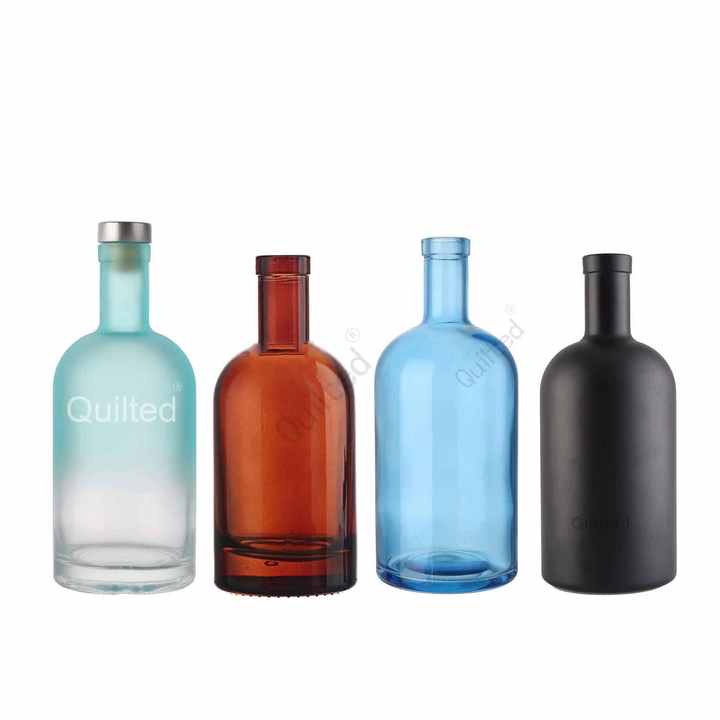
- Blue bottles: Light light-blocking ability, giving people a fresh and natural visual feeling. Suitable for packaging white wine, fruit juice, and some high-end cosmetics.
2.5 Classification by Neck Shape
This classification is based on the length and thickness of the bottle neck, which is related to the use method of the product and the matching of the bottle cap.
- Necked bottles/neckless bottles: Necked bottles have an obvious neck structure, which is convenient for holding and matching with bottle caps; neckless bottles have no obvious neck, and the bottle body is directly connected to the bottle mouth, mostly used for packaging canned food and cosmetics.
- Long-necked bottles/short-necked bottles: Long-necked bottles have a long neck, suitable for packaging liquor, perfume, and other products; short-necked bottles have a short neck, suitable for packaging canned food and daily chemical products.
- Thick-necked bottles/thin-necked bottles: Thick-necked bottles have a thick neck, high mechanical strength, suitable for packaging heavy products; thin-necked bottles have a thin neck, delicate appearance, suitable for packaging high-end cosmetics and perfume.
3. Why Choose QLT Glass Company’s Glass Bottle Packaging Containers?
As a professional manufacturer focusing on glass bottle packaging, we have the following advantages to meet the bulk procurement needs of customers in different industries:
- Diversified product types: We can provide glass bottles of various shapes, sizes, colors, and uses, and support customized design according to customer needs (such as embossed logos, special bottle shapes, etc.).
- Strict quality control: All products have passed national food safety and pharmaceutical packaging standards, with stable chemical properties, no harmful substance leaching, and good sealing performance.
- Efficient bulk production capacity: Equipped with advanced automated production lines, we can complete the production and delivery of large-batch orders (100,000+ bottles) within a short time, ensuring the timeliness of customer production schedules.
- Professional after-sales service: We provide one-stop services from product design, sample production to bulk delivery, and can solve various problems encountered by customers in the use of glass bottles in a timely manner.
If you are looking for a reliable glass bottle packaging container supplier, please contact QLT Glass Company. We will provide you with the most suitable product solutions according to your industry characteristics and procurement needs.
Post time: Nov-20-2025